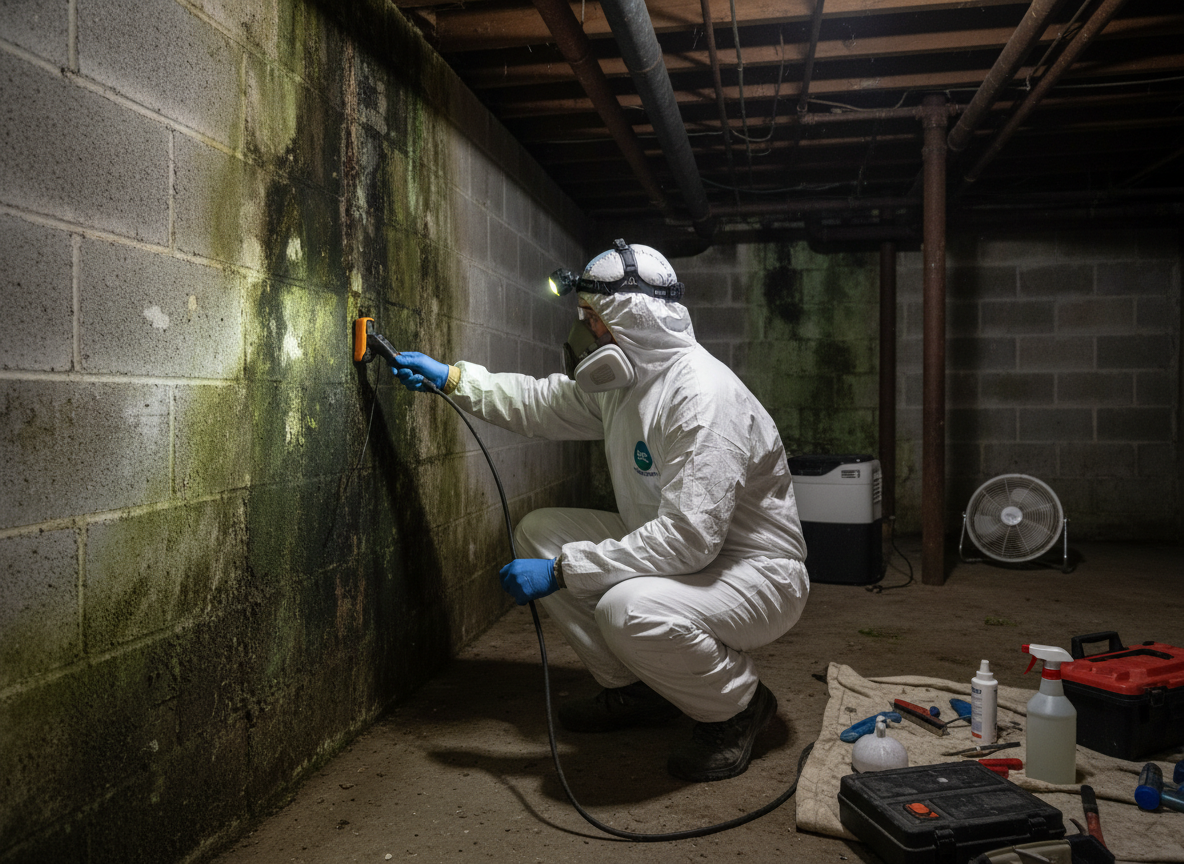
Burton homes often sit on Vashon Island's clay-heavy soils that hold rainwater long after storms pass. This creates persistent dampness along foundation walls and under slabs in houses built from the 1940s through the 1970s. During a basement mold inspection we check behind stored items, along sill plates, and at the base of stairs where airflow is poor. We also look for condensation on cold-water pipes that drips onto unfinished concrete floors during the long wet season.
Many Burton basements were never designed with modern vapor barriers or perimeter drains. When we inspect we pay special attention to the transition between the poured foundation and the wooden sill, a common entry point for groundwater that seeps in during heavy winter rains. Older insulation types such as rock wool or paper-faced batts trap moisture and hide early growth that later releases spores into living spaces above. We document every affected material so homeowners can see exactly what needs removal versus what can be dried in place.
Island terrain means many properties have driveways that slope toward the house or downspouts that empty right at the foundation. These details change how water moves and where mold is likely to appear first. During inspection we trace roof runoff paths and check whether French drains installed decades ago are still functioning or have filled with silt from the island's glacial till.
Common Moisture Pathways in Burton Basements
We map how rainwater from the island's frequent winter storms travels under slabs and through crawlspaces that connect to finished basements. Homeowners often miss the small cracks that open along the back wall where the lot drops toward the Sound.
What Changes the Inspection Scope
Homes with finished lower levels require moisture meter readings behind drywall and under carpet tack strips. Unfinished spaces let us see joist ends and rim boards directly, but still need checking for hidden growth in the cavities of older balloon-framed walls.
Technician insight
In Burton, the thing that catches most people out with Basement mold inspection is how the island's clay soils and older homes without perimeter drains let water sit against the foundation for weeks after a storm. Homeowners check the middle of the floor but miss the damp rim joist right where the siding meets the concrete.
Hidden Growth Behind Stored Boxes
A Burton homeowner noticed a musty smell after a wet November. We traced it to water that had wicked up the back wall under stacked boxes. The inspection showed elevated moisture along the sill plate and early growth on the paper facing of old insulation. We documented the affected sections and outlined drying steps before any removal began.
How it works
- 1
Initial Walk-Through
We start at the exterior to trace roof lines, downspouts, and grade around the foundation before entering the basement.
- 2
Moisture Mapping
Using meters and infrared we record readings on walls, floors, and at sill plates to locate active damp areas.
- 3
Visual and Probing Inspection
We examine every accessible surface, lift carpet edges, and probe suspect insulation or wood for hidden growth.
- 4
Documentation and Recommendations
Findings are recorded with photos and notes so you can decide next steps for drying or remediation.
Pricing
Pricing depends on basement size, finished versus unfinished space, and whether contents must be moved for full access.